

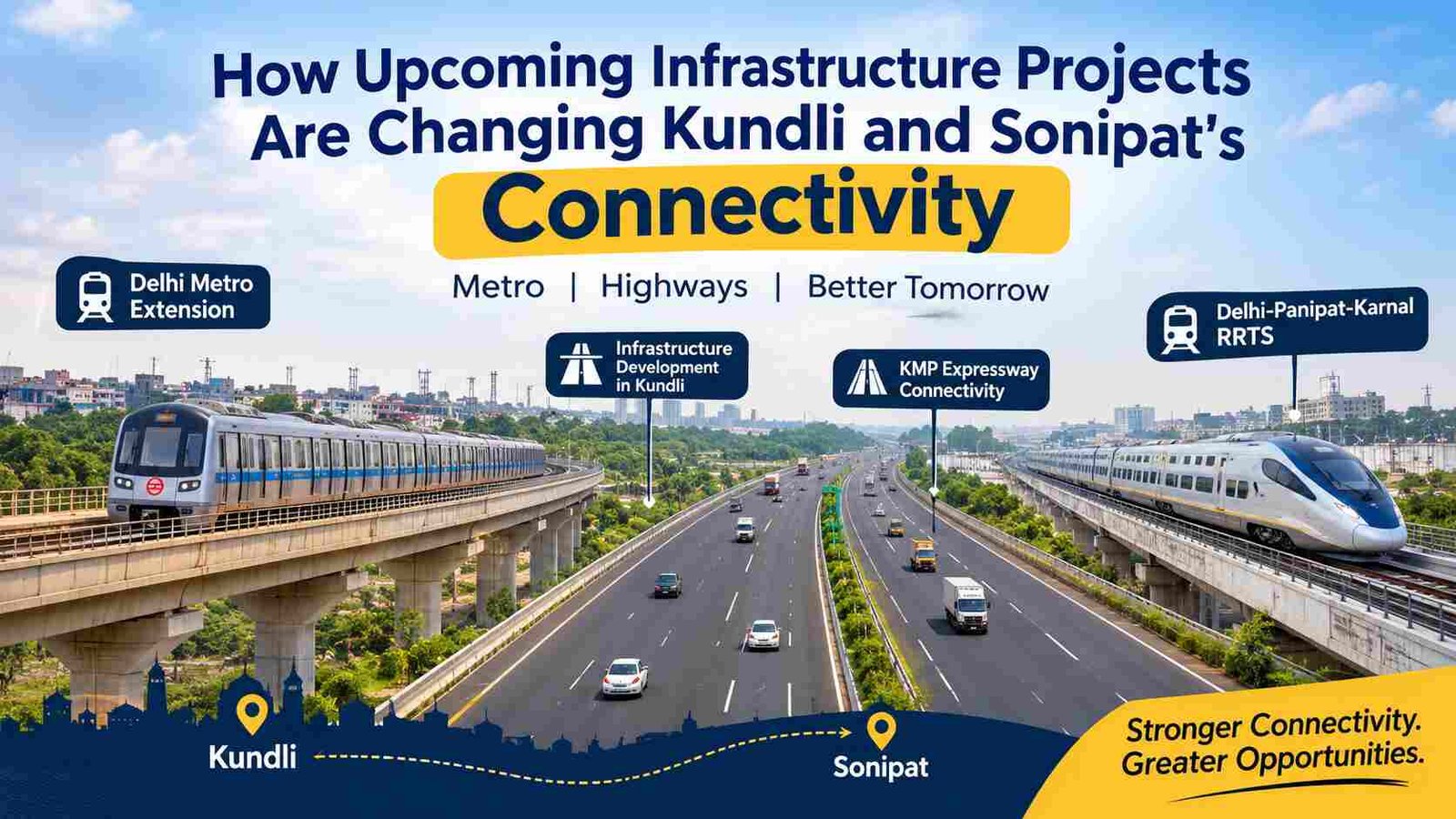
Connectivity holds high significance in the development of any emerging zone. Good roads, transport, and railways help in making connections with cities and markets around the place. Kundli & Sonipat form a larger part of the Delhi-NCR zone where many transport projects are making connectivity with Delhi and other zones in Haryana a reality.
Infrastructure Development in Kundli is not only about building roads in the zone. It includes metro expansion plans, regional rapid transit plans, and industrial transport plans. Knowing about all these plans would enable citizens, entrepreneurs, and buyers to understand development in the zone better.
Understanding Kundli’s Location and Regional Connectivity
Kundli is situated in the Sonipat district of Haryana, near the northern border of Delhi. Its location near the Delhi-Sonipat corridor allows it access to key regional transportation links such as the National Highway 44 (NH-44).
Sonipat also links to a number of industrial and commercial centres located within the state of Haryana. Industrial centres like Rai, Barhi, and Kharkhoda provide for some of the industrial activity in the district. To the business community, this regional network is important in that it is often the basis on which the movement of people, material, and finished products occurs.
In this regard, the Infrastructure Development in Kundli must be seen within the context of this region. Transportation links in and around the Delhi-Sonipat industrial complex can affect movement through this region.
Major Road Networks Supporting Kundli’s Connectivity
The road network continues to play an integral role in the connectivity of the region. The NH-44 is one such significant north-south road that links Delhi to Sonipat and other places in the north. It acts as an enabler of passenger and cargo traffic.
There is yet another major road that forms an alternative route to bypass Delhi, namely the Kundli Manesar Palwal (KMP) Expressway, which is otherwise called the Western Peripheral Expressway. For logistics companies moving their cargo across different industrial locations, peripheral expressways offer great options for routing cargo.
Urban Extension Road-II (UER-II) is yet another road that can be considered in terms of its contribution to the overall Delhi-NCR transportation system. The linkages of the road can help improve connectivity within some sections of Delhi as well as the other regions nearby. But the actual benefits would vary based on the location of the road.
It is important because connectivity not only depends upon the presence of highways but also depends on the local roads, junctions, and service roads.
Infrastructure Development in Kundli: Delhi Metro Extension
Among the important projects that have been undertaken in terms of transport infrastructure in the region is the Rithala-Narela-Nathupur (Kundli) corridor of Delhi Metro Phase IV.
The Union Cabinet has given its approval to this 26.463-km long corridor in December 2024. It consists of 21 stations and aims to extend the present Red Line to Narela and Nathupur in Haryana. This project has been executed by Delhi Metro Rail Corporation.
The corridor is significant because it is planned to connect parts of north-west Delhi with Kundli. It could provide another public transport option for commuters travelling between the two regions.
As of November 2026, the project remains under implementation. The Delhi government’s 2026–27 planning document lists March 2029 as the target completion date and records the project at the tendering stage. This is a target, not a guarantee of the date on which passenger services will begin.
Once operational, the corridor could improve public transport access for commuters. Its actual impact will depend on construction progress, station access, feeder transport and integration with other travel options.
Delhi-Panipat-Karnal RRTS and Regional Travel
The proposed Delhi-Panipat-Karnal Namo Bharat Regional Rapid Transit System (RRTS) is another important project to follow. It is planned as a regional transport corridor connecting Delhi with major locations in Haryana, including Panipat and Karnal.
In March 2026, the Haryana Cabinet approved the corridor proposal. However, the revised Detailed Project Report was still under consideration by the Government of India in NCRTC’s 2025–26 annual report. Haryana also included the corridor alignment in its Transit-Oriented Development policy through a September 2026 notification.
This distinction matters: state-level approval and planning steps do not mean that the entire corridor is already under construction. The project still depends on the required approvals and implementation decisions.
If developed, the corridor could strengthen regional public transport and provide additional travel options for people commuting between Delhi and Haryana. Its direct benefit to Kundli will depend on the final station locations and connections with local transport.
Haryana Orbital Rail Corridor and Industrial Connectivity
The Haryana Orbital Rail Corridor (HORC) is yet another rail infrastructure project that would be relevant to the larger transportation and industry network of the state. It is supposed to connect significant destinations within the state and help in the transportation of both people and cargo.
Rail connectivity may be crucial for Sonipat and other industrial areas in the region for cargo transportation purposes and other related activities. But readers are advised to verify any information about the project from the latest sources before accepting it as factual.
Rail projects can take several years to move through planning, land-related processes, approvals, and construction. Their practical benefits become clearer as the alignment, station locations, and implementation stages are confirmed.
How Better Connectivity Can Support Business and Industrial Activity
Transport infrastructure can influence where businesses choose to operate. Manufacturers, warehouses and distributors often consider highway access, travel time, freight movement and the availability of workers when evaluating a location.
Kundli’s position near NH-44 and the KMP Expressway gives businesses access to important road routes. Its proximity to industrial areas such as Rai and other parts of Sonipat also makes regional connectivity relevant to manufacturing and logistics activity.
The Infrastructure Development in Kundli may support business activity by improving access to markets and transport networks over time. However, infrastructure projects do not automatically create commercial demand or guarantee property price growth. Business decisions also depend on local facilities, land-use permissions, operating costs, workforce availability, and actual market requirements.
As infrastructure projects reshape regional connectivity, working with a knowledgeable Real Estate Agent in Kundli can help businesses understand local locations, connectivity options, and property requirements before making a decision. Rajdhani Industrial Properties helps buyers explore commercial and industrial property options in the Kundli and Sonipat region.
Challenges That Matter Alongside New Infrastructure
Large transport projects often receive attention, but local infrastructure is equally important. Road maintenance, drainage, water supply, public transport access, street lighting, and traffic management affect everyday travel and business operations.
A new metro station or highway connection may improve regional access, but the surrounding area also needs reliable last-mile transport. Similarly, industrial development requires supporting civic facilities and suitable road access for commercial vehicles.
For this reason, Infrastructure Development in Kundli should be assessed through both major transport projects and ground-level facilities. Planned improvements need time, coordination, and effective implementation before their full benefits can be experienced.
What to Watch in Kundli and Sonipat’s Future Development
The region’s connectivity will continue to depend on the progress of several projects. The Delhi Metro extension, the proposed Delhi-Panipat-Karnal RRTS corridor and Haryana’s wider rail and road network are important developments to monitor.
Residents and businesses should follow official project announcements rather than relying only on estimated completion dates or promotional claims. For property-related decisions, it is also sensible to check the distance from a proposed station or highway access point, current road conditions, land-use permissions,s and available civic facilities.
Businesses and buyers exploring property options in the area can also consult experienced Property Dealers in Kundli to understand available properties, location suitability, and local market requirements. Rajdhani Industrial Properties can help buyers assess their commercial and industrial property requirements before comparing available options.
The Infrastructure Development in Kundli presents opportunities for better regional access, but its long-term impact will depend on how effectively projects are completed and connected with local infrastructure. Rajdhani Industrial Properties encourages buyers and business owners to consider connectivity alongside permissions, local facilities,s and practical business needs.
If you are exploring commercial or industrial property options around Kundli and Sonipat, contact us to discuss your requirements and get guidance on suitable locations for your needs.
Frequently Asked Questions
What are the major infrastructure projects around Kundli and Sonipat?
Major developments to follow include the Rithala-Narela-Nathupur Delhi Metro corridor, NH-44, the KMP Expressway, the proposed Delhi-Panipat-Karnal RRTS corridor, and the Haryana Orbital Rail Corridor.
How will the Delhi Metro extension benefit Kundli?
The Delhi Metro corridor expansion is supposed to connect Kundli and Nathupur to Narela as well as the northwestern parts of Delhi. Once it is operational, commuters can use this mode of transportation too.
What is the importance of the KMP Expressway for Sonipat?
The KMP Expressway provides a peripheral road connection across Haryana and helps traffic travel around Delhi. It is relevant for regional movement, logistics, and access to industrial locations.
Is the Delhi-Panipat-Karnal RRTS corridor operational?
No. It is a proposed regional rapid transit project. Although Haryana has taken approval and planning steps, NCRTC’s 2025–26 annual report stated that the revised DPR was under consideration by the Government of India.
Can infrastructure development increase property demand in Kundli?
Better connectivity can influence business and property decisions, but it does not guarantee higher prices or returns. Buyers should also assess location, permissions, civic facilities, market demand,d and project completion status.